Your Sleep Apnea Treatment Only Works If You Can Actually Use It.
CPAP can be highly effective. But if the mask spends more time on the nightstand than on your face, your sleep apnea still needs to be treated.
Many patients who come to the TMJ & Sleep Therapy Centre of Temecula already know they have obstructive sleep apnea. They have completed the sleep study, received the diagnosis, and been prescribed CPAP. The problem is that knowing what you should use and being able to sleep with it every night are two very different things.
Dr. Nathan Jergensen provides dental sleep medicine options for patients seeking an alternative to CPAP or another way to make their existing sleep apnea treatment more manageable. For appropriately selected patients, a custom oral appliance can help maintain the airway during sleep without requiring a mask, hose, or bedside machine.
The $400 Comprehensive Exam
About 60 minutes with Dr. Jergensen. Diagnosis and complete treatment plan at your first visit.
- Credited toward treatment when you start within 7 days
- Refunded if Dr. Jergensen can’t help you
- CBCT 3D imaging, joint vibration analysis, airway measurement and more, as your condition calls for
Mon–Fri 8:00am – 4:30pm · or request online
If CPAP Is Working for Your Sleep Apnea but Not for Your Life, You Have Other Options.
CPAP works by providing continuous positive airway pressure to help prevent the airway from collapsing during sleep. When patients can use it consistently, it can be an effective treatment for obstructive sleep apnea.
Can’t Tolerate CPAP? You May Have Another Option
But some patients struggle with the mask itself, pressure, claustrophobia, dry mouth, air leakage, noise, travel, or simply the difficulty of sleeping comfortably while attached to a machine. Others begin with good intentions but gradually find themselves using CPAP less and less.
The answer is not to pretend untreated sleep apnea is acceptable. It is to determine whether there is another clinically appropriate way to manage it.
Being Tired Is Only Part of the Problem.
Obstructive sleep apnea occurs when the airway repeatedly becomes restricted or collapses during sleep, interrupting normal breathing and preventing the body from maintaining healthy, restorative sleep.
Some patients know something is wrong because they snore loudly or their partner notices pauses in their breathing. Others wake with headaches or dry mouth, struggle with daytime fatigue and brain fog, or sleep for what should be enough hours and still wake feeling exhausted.
Treating sleep apnea is about more than getting rid of snoring or feeling more rested. The goal is to maintain effective breathing during sleep with a treatment that is appropriate for your diagnosis and realistic enough to use consistently.
What If Treating Your Sleep Apnea Did Not Require a Mask?
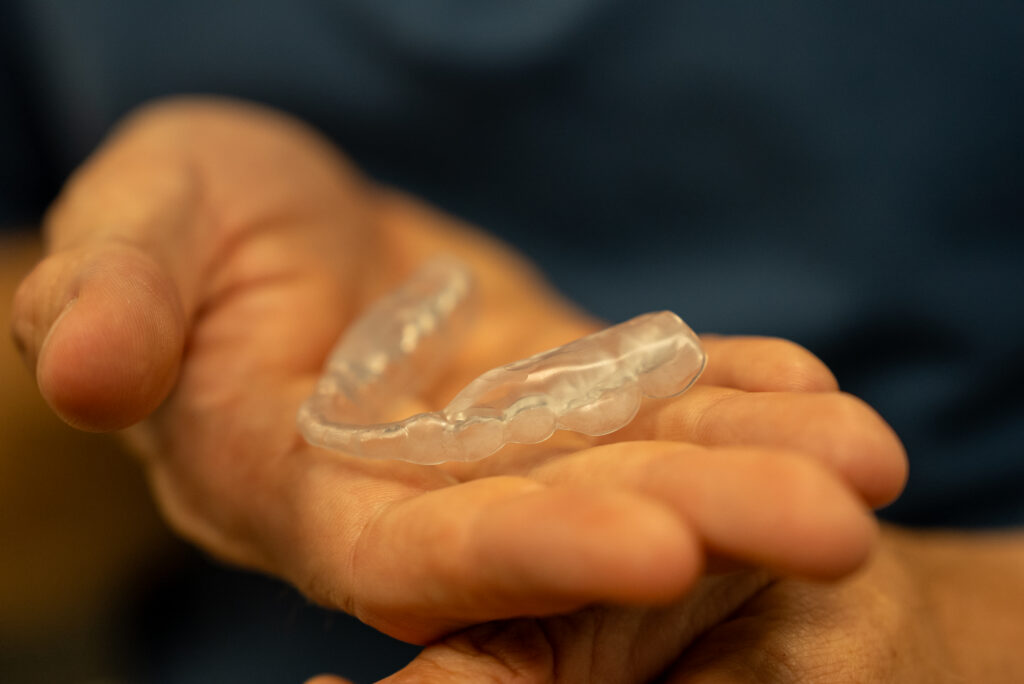
For appropriately selected patients, oral appliance therapy provides another way to manage obstructive sleep apnea. A custom appliance is worn inside the mouth while you sleep and positions the lower jaw in a way intended to help maintain space within the airway.
There is no mask covering the face, no hose, and no bedside machine. The appliance is compact, portable, and designed specifically for the individual patient.
That convenience matters, but convenience alone is not enough. The appliance still needs to be clinically appropriate for your condition and positioned according to how your anatomy and airway respond.
This Is Not a Snoring Mouthpiece From the Internet.
Over-the-counter devices may look similar to a professionally prescribed oral appliance, but appearance is only part of the equation. Effective oral appliance therapy requires attention to the patient’s diagnosis, anatomy, jaw position, bite, comfort, and airway.
Dr. Jergensen evaluates those factors before prescribing an appliance and monitors the patient after treatment begins. The objective is not simply to move the jaw forward as far as possible. It is to identify a position that supports the airway while accounting for the jaw joints, bite, and surrounding structures.
A device that happens to fit inside your mouth is not the same as a treatment designed around you.
We Do Not Guess How Your Airway Responds When Your Jaw Moves.
Moving the lower jaw can influence the space available within the airway, but every patient is different. Dr. Jergensen uses diagnostic information to understand the relationship between jaw position and airway dimensions before determining how oral appliance therapy should be approached.
Acoustic pharyngometry measures airway size and demonstrates how airway dimensions change as the jaw is repositioned. Combined with the patient’s sleep apnea diagnosis, clinical examination, and other relevant findings, this information helps guide treatment planning.
The goal is precision, not simply advancement.
Oral Appliance Therapy Is an Option. It Is Not the Answer for Everyone.
Whether an oral appliance is appropriate depends on the patient’s sleep apnea diagnosis, anatomy, jaw and dental health, treatment history, and other clinical considerations. Some patients may be good candidates for oral appliance therapy as an alternative to CPAP. Others may be better served by continuing PAP therapy, using a combination approach, or pursuing additional medical evaluation.
That is why the process begins with evaluation rather than simply ordering an appliance. Dr. Jergensen’s role is to determine whether dental sleep medicine can appropriately contribute to your treatment and, if so, how.
Sometimes the Best CPAP Alternative Is Not Giving Up CPAP Completely.
Treatment does not always have to be an either-or decision. Some patients who struggle with CPAP may benefit from combining an oral appliance with PAP therapy. Repositioning the jaw can change the airway in ways that may make PAP therapy more manageable for appropriately selected patients.
For someone who knows CPAP is effective but struggles to tolerate it consistently, combination therapy can provide another treatment pathway worth evaluating.
The objective is not to prove that one treatment is better than another. It is to find an effective approach the patient can realistically maintain.
Sleep Apnea Is a Medical Condition. Treatment Should Reflect That.
Dr. Jergensen’s role in dental sleep medicine is part of a larger continuum of sleep apnea care. Diagnosis and medical management may involve the patient’s physician or sleep specialist, while Dr. Jergensen evaluates and provides oral appliance therapy when dental treatment is appropriate.
Communication between providers is important because successful treatment is not simply about delivering an appliance. The objective is to manage the diagnosed sleep disorder appropriately and verify that the selected treatment is doing what it is intended to do.
Sometimes the Airway Problem Is Not the Same as the Sleep Apnea Treatment Problem.
Snoring occurs when airflow causes tissues within the airway to vibrate during sleep. It can exist on its own or occur alongside obstructive sleep apnea, which is why persistent snoring deserves appropriate evaluation rather than being treated only as a nighttime annoyance.
Depending on the patient, Dr. Jergensen may recommend oral appliance therapy, NightLase treatment for snoring, or a combination of approaches. When additional sleep evaluation is necessary, a sleep study should occur before deciding how the problem is treated.
Start With the Diagnosis You Already Have. Then Find the Treatment You Can Live With.
If you have already completed a sleep study or been diagnosed with obstructive sleep apnea, that information becomes an important part of Dr. Jergensen’s evaluation. He will review your history, your experience with CPAP or other previous treatment, and the factors that may influence whether oral appliance therapy is appropriate.
If you are a candidate, a custom appliance can then be designed around your clinical findings. Follow-up care allows Dr. Jergensen to evaluate comfort, jaw function, appliance positioning, and your response to treatment while coordinating additional sleep assessment when appropriate.
This is not simply about replacing one device with another. It is about finding an effective treatment strategy that works outside the doctor’s office, where you actually have to use it.
The Best Sleep Apnea Treatment Is the One That Is Effective and You Can Consistently Use.
If your CPAP is sitting unused, you are traveling without it, or you dread putting the mask on every night, you do not need to feel guilty about struggling with treatment. You do need another plan for managing your sleep apnea.
Dr. Jergensen can evaluate whether custom oral appliance therapy or another dental sleep medicine approach may be appropriate for you. The goal is not to talk you out of a treatment that works. It is to help you find an effective treatment you can realistically make part of your life.
- Credited toward treatment when you start within 7 days
- Refunded if Dr. Jergensen can’t help you
- Financing available